Bone density scan (dexa / dxa)
Find out about bone density scans, how to prepare for your scan, and how to understand your results, including your T score.

A bone density scan can help to assess how strong your bones are and your chance of osteoporosis and future broken bones. This scan is sometimes called a bone mineral density scan which is shortened to DEXA or DXA.
On this page, we explain what a bone density scan is, how it works and what your results may mean.
What is a bone density scan?
A bone density scan measures your bone density. Bone density is just one thing that helps us to understand the strength of your bones (like saying that high cholesterol is one risk factor for a heart attack). Other factors, such as your age and family history cause bones to weaken in ways not shown by the bone density scan. These will be considered alongside your bone density scan result to understand your chance of breaking a bone in the future. If you have a high chance of breaking a bone you will be offered an osteoporosis medicine.
Watch: Your questions answered
What is bone density? How should I prepare for my bone density scan? This video, from Keele Universiy, answers these common questions and more.
Do I need a bone density scan?
You may be referred for a bone density scan if:
you’ve broken a bone
you have symptoms of spinal fractures, such as height loss, change in posture or unexplained back pain
you have factors, such as your age or family history that increase your chance of osteoporosis and broken bones
your bone strength is being assessed
you may benefit from an osteoporosis medicine.
You may be offered an osteoporosis medicine without having a bone density scan. This is more common if you are over the age of 75 because the scans are not as accurate when you get older. Bone density is also just one part of your bone strength check. It’s not always needed to assess if you would benefit from medicine.
A bone density scan is not done to provide information about cancer, pain or osteoarthritis.
If you think you need a bone density scan talk to your doctor. It can be helpful to discuss why you think you need a scan. For example, if you’ve broken a bone or have a factor that increases your chance of osteoporosis.
How does a bone density scan work?
A bone density scan uses very low dose X-rays to measure the density of your bones. The amount of radiation is similar to the amount we would get from three days of normal life. This means it’s very safe. But, if you are pregnant, you will need to rearrange your appointment.
How to prepare for a scan
What should I wear for the scan?
On the day of your scan try to wear clothes without metal objects such as zips, heavy buttons, fasteners, belts or underwired bras. Metal objects can get in the way of the scan pictures. A hospital gown will be available on the day if needed.
Do I need to bring anything with me to the scan?
Please bring a list of your medicines to your appointment. You do not need to stop any medicines for this scan. You can also eat and drink as normal before your scan.
You may be asked to complete a simple questionnaire before your appointment. This will include questions about your family history, medical history and the date / year of your last period, if appropriate. This questionnaire helps to give healthcare professionals more information about your bone health. If you are sent the questionnaire in advance, please bring it to your appointment. You may be given the questionnaire at your appointment if it is not sent in advance.
Can I bring anyone with me?
Yes, you can bring someone with you to your appointment. They may be asked to wait outside the room while the scan is being done.
What to expect at the scan
What does the scan involve?
The scan is usually carried out by a radiographer, a technician or a specially trained nurse.
On the day of the scan you will be asked to lie on your back, on a firm couch. A scanning arm passes over your body and takes images of your lower spine and hips - two of the most common places where bones break. Sometimes you will also have your wrist scanned.
You might hear people talk about scanning your femoral neck. This is the top of your thigh bone. It is sometimes called the ‘neck of femur’ or ‘NOF’. Despite its name, it is not related to your neck.
Most people have a good experience with this scan. You don’t go into a tunnel or need an injection.
If you can’t lie flat on your back let the scanning department know before your appointment. They may not be able to do the scan.
The scan takes around 20 minutes.
A vertebral fracture assessment (VFA) is a type of scan that helps to identify broken bones in the spine (spinal fractures). It uses a bone density scanner.
It is sometimes carried out at the same time as your bone density scan, using the same machine. You may need to lie on your side for part of it.
Not all hospitals can do VFA scans so you may be referred for an X-ray to look for spinal fractures instead.
Some bone density machines can scan other parts of the body. This includes your forearm. These scans are less common and usually only done if:
it’s not possible to scan your hip and spine
you have a condition that affects the bone density in your forearm such as hyperparathyroidism.
Watch: What to expect at the scan
Watch our video to find out what to expect at a bone density scan. We will guide you through everything you need to know, including:
what happens on the day of your scan
what the scanner looks like
what you will need to do during the procedure.
What happens after the scan?
How long will I have to wait for my results?
Your results are usually available around three weeks after your scan. But you may have to wait longer for your results if you're waiting for an appointment.
The department should tell you what waiting times to expect. You will usually get your results via an email, text, letter or phone call. You may get your results in a face-to-face meeting with a healthcare professional.
If you have not received your results within the expected time, you should contact the healthcare professional who referred you to ask if your results are ready.
What do my bone density scan results mean?
The results of your scan give information about your bone density. Your bone density scan is just one part of assessing your bone strength. The scan results are usually put together with other information, including a fracture risk assessment.
A fracture risk assessment is a questionnaire used by healthcare professionals to understand your bone’s strength. The most common fracture risk assessment is called FRAX. It will assess your chance of breaking a bone and if you would benefit from an osteoporosis medicine. The fracture risk assessment will include your height, weight and other factors linked to bone strength. It will also include your bone density scan result if you’ve had one. Depending on the results of your bone density scan and fracture risk assessment, you may be offered:
an osteoporosis medicine
lifestyle advice that can help to strengthen your bones
further tests, such as a blood test - your health professional will contact you if this is relevant
a follow-up scan to monitor your bone density in two to five years.
What does my T-score mean?
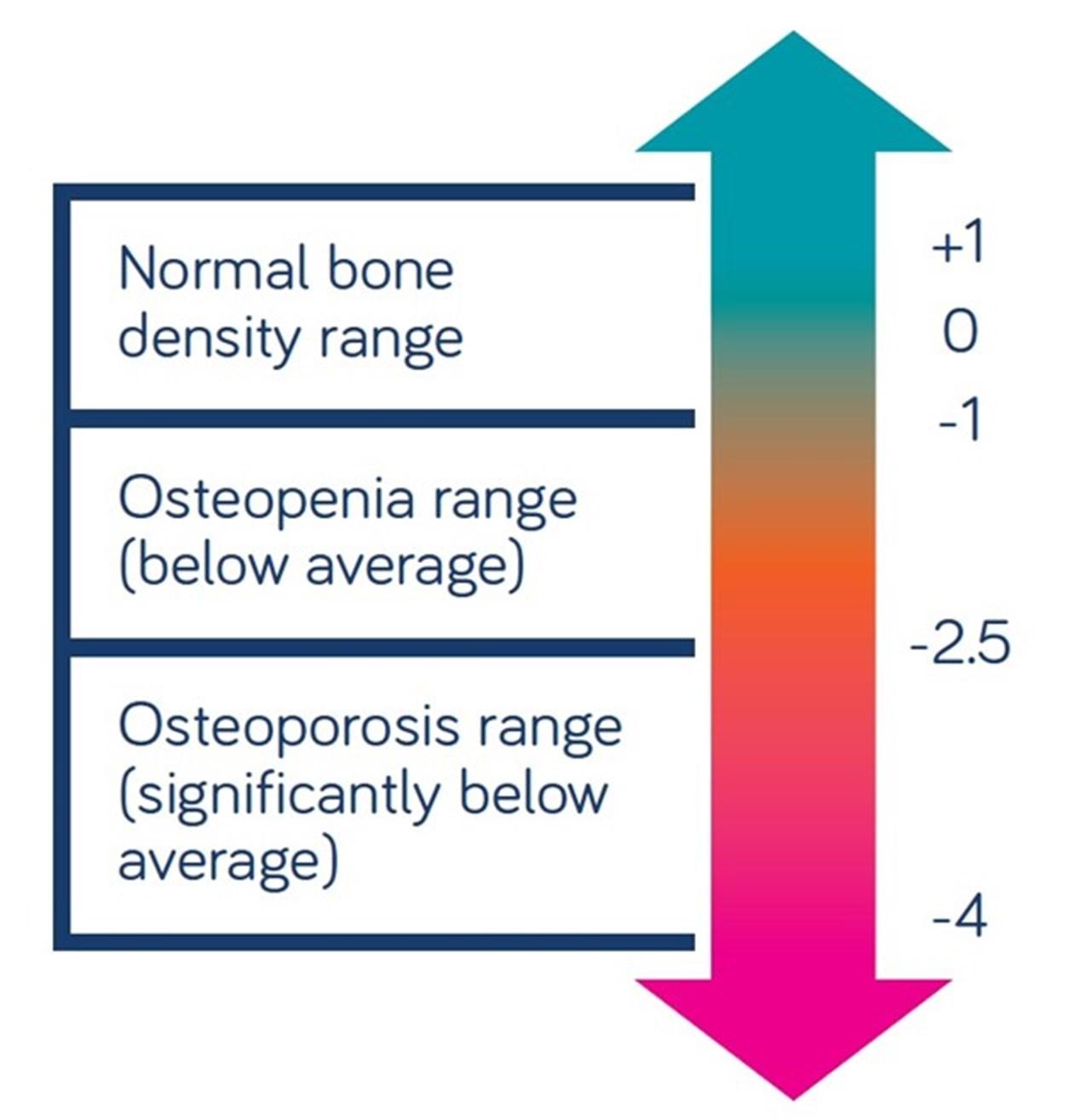
The result of your bone density scan may be given as a number called a T-score. A T-score compares your bone density to the normal range found in young healthy adults:
Normal (+1 to -1) - Your bone density is in the normal range for a young adult.
Low bone density (-1 to -2.5) - Your bone density is slightly below the normal range for a young adult. This is also known as the osteopenia range. This score is expected in older adults.
Osteoporosis (-2.5 and below) - Your bone density is much lower than the normal range for a young adult. This is also known as the osteoporosis range.
The scores help guide if you may benefit from a medicine. Usually, the lower the score the more likely you are to benefit from an osteoporosis medicine. But your bone density scan results do not give a complete picture of your bone strength. This means you could be told you are in the osteoporosis range but would not benefit from medicine. Or you could be in the osteopenia range and be recommended medicine. This is why a full fracture risk assessment is so important.
Your bone density increases as your bones grow. Your bone density will be at its highest around the age of 30. It will then start to go down. This happens quicker after the menopause, but bone density decreases in both men and women. This means it is normal for your bone density scan results to change with age.
You may be given your results as a Z-score, alongside your T-score.
A Z-score compares your bone density to people of the same age as you. It is normally only useful for looking at the bone strength of children and young adults.
Having a Z score that is lower than expected for your age may indicate that another condition is affecting your bone density levels. In this case, you may be offered further tests to look for conditions which are linked with osteoporosis. Although low density is normally linked with osteoporosis, other conditions can cause low bone density. These include osteomalacia and osteogenesis imperfecta (brittle bone disease).
Will I need another scan?
Your doctor may suggest another bone density scan in the future. Bone density scans can be useful to:
monitor your bone strength
reassess if you would benefit from an osteoporosis medicine
support an osteoporosis medicine review.
You will normally have a scan every two to five years. The reason for this is bone density changes very slowly over time. If you have scans too close together you will not see any change.
At your follow-up scan we would expect to see a slight decrease in bone density. This is because in adults aged over 30, bone density goes down a bit each year. This can mean, if your bone density stays the same between scans or slightly lowers, it is a positive result.
If you need more scans, it's best to have them at the same hospital and, if possible, on the same machine. This makes it easier to compare the results and see any changes over time.
Related videos
Thank you to Keele University for their support developing this information.
About this information

Get news and updates via your inbox
Don't miss our expert insights, recipes, and tips for living well with osteoporosis.

Connect with people living with osteoporosis
Our online community is a welcoming and safe space for you to share your experiences and find peer support.