
Summary
Croydon has developed a borough-wide approach to identifying people at risk of osteoporosis before they fracture. Starting as a clinician-led quality improvement project, the programme now uses community pathways, primary care systems and digital case-finding to support earlier diagnosis, improve treatment initiation and reduce missed opportunities for prevention.
At a glance
A clinician-led quality improvement programme in Croydon has developed into a borough-wide locally commissioned service, helping identify people at risk of osteoporosis earlier and reduce avoidable fractures.
Led by Adam Gregory, Advanced Practitioner Physiotherapist at Croydon Health Services NHS Trust, the programme brings together primary care, community services and fracture prevention pathways to support earlier diagnosis and more proactive care.
Why change was needed
Fragility fractures linked to osteoporosis have a major impact on patients, families and NHS services, yet many people are still diagnosed only after they break a bone.
How the programme supports national priorities
The Croydon model complements Fracture Liaison Services by extending case-finding beyond acute fracture pathways and into community and primary care settings. This supports earlier diagnosis, particularly for women aged 50 and over, and reflects NHS priorities around prevention, community-based care and digital transformation.
What the programme set out to do
The programme set out to embed proactive bone health risk identification across Croydon by:
Identifying osteoporosis and fracture risk earlier
Building bone health into routine community and RESTART triage workflows
Using primary care systems to support repeatable case-finding
Enabling a sustainable GP-led locally commissioned service. How the programme developed
Phase 1: building capability in community services
Introduced FRAX-based risk assessment across community and therapy teams
Delivered targeted education to improve clinician confidence
Identified more than 500 at-risk patients, with over 60% progressing to diagnosis or treatment. At this stage, however, I started to understand the need for more systematic approaches to identification.
Phase 2: embedding bone health into RESTART triage
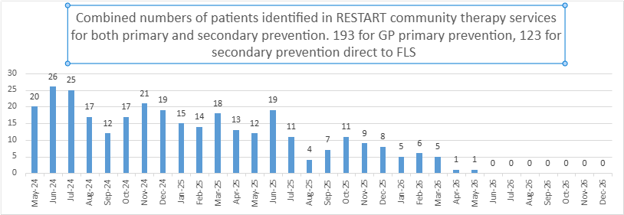
Embedded bone health into RESTART triage templates and workflows
Identified 316 patients through direct FLS referral and GP-led primary prevention routes. Interestingly, as internal pathways around identification within acute areas improved, this led to a reduction in identification at point-of-therapy triage, suggesting improved acute case finding
Phase 3: using digital tools in primary care
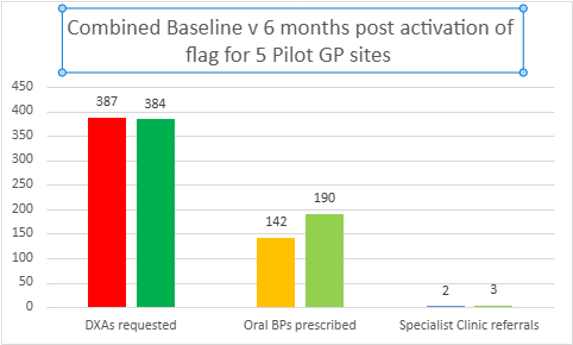
Worked in collaboration with EMIS to implement clinical alerts across five GP pilot practices, data accumulation period January 2024 to April 2026
Increased oral bone-protective prescribing from 142 to 190 in a 6 months pre and 6-month post-alert activation period. Representing a 34% increase across pilot sites.
Improved consistency of DXA requesting across sites
Phase 4: moving to a borough-wide commissioned service
Moved from pilot innovation to a borough-wide locally commissioned service from April 2026 as the first of two parts of the locally commissioned service, working in tandem within plans for shared care around aspects of parenteral treatments.
As part of the locally commissioned service, all GP practices are expected to run quarterly searches for people aged 50 and over and meeting the agreed criteria. They then follow the South West London Bone Health pathway.
Shifted identification from clinician-led activity to embedded, repeatable system processes with potential, further to demonstrable success to expand beyond Croydon place.
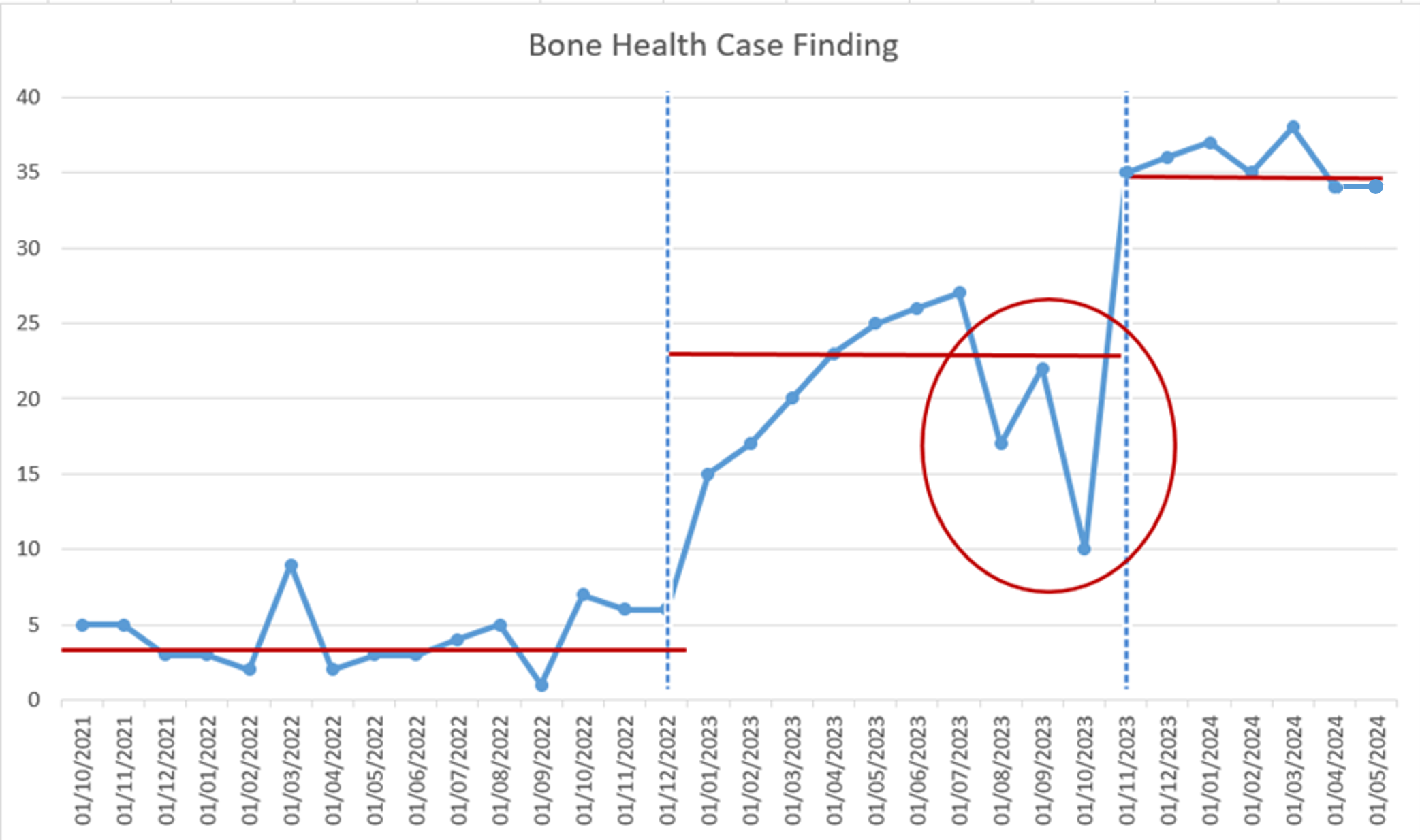
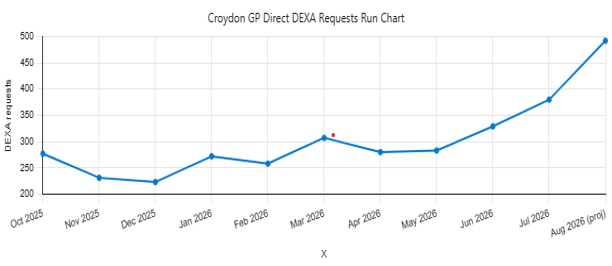
Early indications are that there is already impact with the locally commissioned service, with 32% of patients screened using the agreed search going on to require DXA scan investigation. The chart below shows the wider impact across all Croydon GP sites, with a clear increase since June 2026 after an initial lag post commencement of LCS in April. This will inevitably, we expect lead to early identification and diagnosis of more patients, a good proportion of which would be expected to be primary prevention cases.
What has changed
More than 500 at-risk patients were identified in the early phases, with over 60% progressing to diagnosis or treatment, establishing a proof of concept of the local unmet need.
A further 315 patients were identified through RESTART community therapy teams from streamlined triage processes.
Bone-protective prescribing, DXA requesting and auditability improved across pilot settings.
The model has demonstrated potential economic value, with projected savings of around £442k through secondary prevention and up to £1.2m when primary prevention is included. This was based on the Phase 1 findings alone, which helped demonstrate the vast potential that can result from the growth within phases 2-4.
What helped make it work
Strong clinical leadership and frontline engagement
Integration into existing triage and digital systems
Clear clinical and economic value
Alignment with commissioning priorities
Robust audit, data and reporting infrastructure
Challenges to manage
Variable GP engagement and uptake
Workforce turnover and competing operational pressures
The need for sufficient data, diagnostic capacity and pathway support at scale.
Learning for other areas
Prevention is more sustainable when built into everyday systems and digital workflows.
Primary care has a vital role in identifying people before they fracture.
Quality improvement helps teams test, refine and build confidence before wider commissioning.
Next steps
Over the next three years, the programme will focus on engaging all Croydon GP practices, increasing identification and treatment initiation, strengthening outcome tracking and exploring wider spread across South West London. In the short term, there will be a focus on training delivery and engagement within GP surgeries/PCN level. This will include the aim for collaborative work with ROS around the role of potential resources such as BoneMed Online to aid the onward journey for patients, to match the expected increase in identification.
Conclusion
The Croydon programme shows how local teams can move from small-scale quality improvement to a sustainable, borough-wide approach to osteoporosis identification.
By bringing together primary care, community services, digital case-finding and fracture prevention pathways, it offers a practical model for embedding prevention into everyday care from end to end of the pathway.