
Whistleblowing policy
1. Introduction
1.1 The Royal Osteoporosis Society ("the charity ") acknowledges it has a duty to always conduct its affairs with the highest standards of integrity, propriety, accountability and openness. This policy is intended to promote throughout the charity a culture of openness and a shared sense of integrity, by inviting all employees, officers, consultants, contractors, volunteers, casual workers and agency workers (together "charity representatives") to act responsibly in order to uphold the reputation of the charity and maintain public confidence.
1.2 The charity acknowledges that all organisations face the risk of things going wrong from time to time, or of unknowingly harbouring illegal or unethical conduct. A culture of openness and accountability is essential in order to prevent such situations occurring and to address them when they do occur. The Public Interest Disclosure Act 1998 is an Act which protects ‘workers’ who ‘blow the whistle’ and raise concerns about wrongdoing. The Employment Rights Act 1996 makes provision for the kinds of disclosures which may be protected; the circumstances in which such disclosures are protected; and the persons who may be protected. These provisions are set out within this policy.
1.3 The aims of this policy are:
To encourage charity representatives to report suspected wrongdoing as soon as possible, in the knowledge that their concerns will be taken seriously and investigated appropriately, and that their confidentiality will be respected.
To provide charity representatives with guidance as to how to raise those concerns.
To reassure charity representatives that they should be able to raise genuine concerns without fear of reprisals, even if they turn out to be mistaken.
For the avoidance of doubt, this policy does not form part of any employee's contract of employment and the charity may amend it at any time.
To ensure that members of the public have a forum to raise any concerns they may have.
2. Purpose and Scope
2.1 This policy and procedure is intended to give general guidance only and should not be regarded as a complete statement of the law. The Charity encourages charity representatives and members of the public to raise genuine concerns about malpractice or impropriety at the earliest practicable stage and in most cases charity representatives should be able to make disclosures about wrongdoing to any senior manager within the Charity so that problems can be identified and resolved quickly. However, there may be occasions where a charity representative feels this policy may be more appropriate.
2.2 This policy sets out a process whereby charity representatives or members of the public who have concerns about malpractice or impropriety may, raise those concerns at a high level in the charity, outside of normal line management, and without fear of detriment.
3. Legal Framework
3.1 What can be disclosed - "Qualifying Disclosure” Whistleblowing is the disclosure of information which relates to suspected wrongdoing or dangers at work. Certain kinds of disclosures qualify for protection (“qualifying disclosures”). Qualifying disclosures are disclosures of information which the charity representative reasonably believes tend to show one or more of the following matters is either happening now, took place in the past, or is likely to happen in the future:
This may include:
criminal activity;
failure to comply with any legal or professional obligation or regulatory requirements;
miscarriages of justice;
danger to health and safety;
damage to the environment;
bribery under our Anti-corruption and Bribery Policy;
financial fraud or mismanagement;
breach of charity internal policies and procedures including our Code of Conduct;
conduct likely to damage the charity’s reputation or financial wellbeing;
unauthorised disclosure of confidential information;
negligence;
the deliberate concealment of any of the above matters.
A whistleblower is a person who raises a genuine concern relating to any of the above.
If a charity representative has any genuine concern relating to suspected wrongdoing or danger affecting any of the charity activities (a whistleblowing concern) they should report it under this policy. It should be noted that in making a disclosure the charity representative must have a reasonable belief that the information disclosed tends to show one or more of the offences or breaches listed above. The belief need not be correct – it may be discovered subsequently that the charity employee was in fact wrong – but the Charity Employee must show that they held the belief, and that it was a reasonable belief in the circumstances at the time of the disclosure.
This policy should not be used for complaints relating to personal circumstances, such as treatment at work. In those cases employees should use the Grievance Procedure or Dignity at Work Policy as appropriate.
Advice should be sought from the Whistleblowing Officer (the People & Governance Advisor) should it be unclear which policy to refer to. In the event of the People & Governance Advisor’s absence, the Whistleblowing Officer will be the Head of HR.
3.2 Making a qualifying disclosure to the Royal Osteoporosis Society
The person making the disclosure should as soon as practicable disclose in confidence the grounds for the belief of malpractice or impropriety to one of the ‘Named Person’s’ (as identified in Appendix 1). The charity representative may tell them in person or put the matter in writing if they prefer. They may be able to agree a way of resolving the concern quickly and effectively. In some cases they may refer the matter to the Whistleblowing Officer (the People & Governance Advisor). The charity representative may seek a confidential meeting with the Chief Executive to discuss whether it would be appropriate to make a formal disclosure under this procedure. The charity representative seeking or taking part in such a meeting is guaranteed the same protection against personal detriment as is given under the procedure to someone making a formal disclosure, whether or not a formal disclosure follows.
3.3 Making a Qualified Disclosure to a Prescribed Person
The charity will deal with raised concerns fairly and in an appropriate way. However, should the charity representative have concerns about the way in which the charity has handled the concern, he/she is able to raise their concerns with a person or body which has been prescribed by the Secretary of State for the purpose of receiving disclosures about the matters concerned detailed in Appendix 2. The persons listed have statutory functions and can provide authoritative advice and guidance to charity representatives about matters properly disclosed to them.
Please see appendix 4 for how the Charity Commission specifically can help with reporting serious wrongdoing at a charity as a worker or volunteer.
If contemplating making a wider disclosure, the charity strongly advises all charity representatives to first seek further specialist guidance from a professional or other representative body.
The charity also recognises that whistleblowers may, after taking account of advice, wish to continue to raise their concerns using other avenues. These might include MPs or the media. All whistleblowers should bear in mind that this action, if completed unjustifiably could result in disciplinary action and could undermine public confidence in the charity.
However, disclosure may attract statutory protection from victimisation / other detriment where all of the following apply:
The whistle-blower has an honest and reasonable suspicion that the malpractice / wrongdoing has occurred, is occurring, or is likely to occur;
The whistle-blower honestly and reasonably believes that the information and any allegation contained within it are substantially true;
The disclosure has not been made for personal gain;
The concern has been raised with the charity or prescribed regulator (unless there was a reasonable belief of victimisation, there was no prescribed regulator and there was reasonable belief there would be a cover up); and
The matter was exceptionally serious.
3.4 Making a Qualifying Disclosure as a member of the public
The charity recognises the need to encourage all members of the public with concerns about any aspect of the charity 's work to come forward and voice those concerns. Usually these concerns are easily resolved. However, when they are about unlawful conduct, financial malpractice or dangers to the public or the environment, it can be difficult to know what to do. Specific examples could include:
A criminal offence (e.g. fraud, corruption etc.) may have or has been committed;
A miscarriage of justice has been or is likely to occur;
The health or safety of an individual has been or is likely to be endangered;
Funds are being used in an unauthorised manner;
The environment has been or is likely to be damaged;
The charity’s own rules/policies have been or are being breached;
Abuse (e.g. physical or verbal) of an employee, volunteer or member of the public
Discrimination towards an employee, volunteer or member of the public (e.g. disability, race, gender).
The deliberate attempt to conceal any of these matters
The charity will do its best to protect a member of the public’s identity when a concern is raised and the said person does not wish for their name to be disclosed (information relating to the investigation will be strictly controlled on a need to know basis). Should a member of the public ask for their identity to be kept confidential, we will not disclose it without their consent or unless we are required to do so by a Tribunal, Court of Law or an Act of Parliament (such as the Freedom of Information Act). If the situation arises where we are not able to resolve the concern without revealing the identity (e.g. a statement may be required as part of the evidence from the member of the public) we will discuss with them whether and how we can proceed.
The disclosure can be made to a ‘Named Person’ as identified in Appendix 1 or alternatively to a ‘Prescribed Person’ as identified in Appendix 2, as outlined in section 3.2 and 3.3 above.
Please see further information on how to make a complaint about a charity in section 5. Good Practice and Supporting Documents - Charity Commission guidance on making complaints about charities: https://www.gov.uk/government/publications/complaints-about-charities and https://www.gov.uk/complain-about-charity
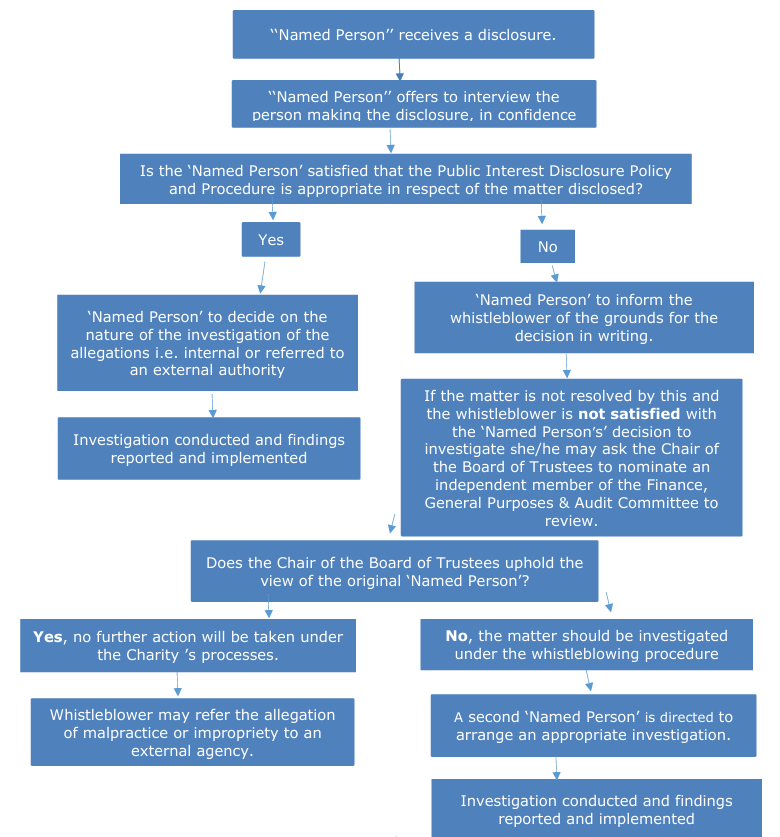
4. The Procedure (Refer to Appendix 3 for flowchart)
4.1 On receipt of the disclosure, the ‘Named Person’ will offer to interview, in confidence, the person making the disclosure. Such an interview will take place as soon as practicable after the initial disclosure. The purpose of the interview will be for the ‘Named Person’ to obtain as much information as possible about the grounds of the belief of malpractice and to consult about further steps which could be taken to investigate the concern further.
4.2 The person making the disclosure may be accompanied by a representative or if an employee, a work colleague, at the interview. The companion must respect the confidentiality of the disclosure and any subsequent investigation. The ‘Named Person’ may be accompanied by an administrative assistant to take notes. The notes will not identify the person making the disclosure. For safeguards in relation to confidentiality, see below.
4.3 Where the ‘Named Person’ is satisfied that this procedure is appropriate, she/he shall decide on the nature of the investigation of the allegations. This may be an internal investigation by a charity employee; or referral of the matter to the police or other appropriate public authority; or the commissioning of an independent enquiry, for example by the charity auditors.
4.4 If the ‘Named Person’ decides that the whistle-blowing procedure is not appropriate in respect of the matter disclosed, she/he shall inform the whistle-blower, giving reasons in writing. These could be on the grounds that the matter should be, is already or has already been the subject of appropriate proceedings under one of the charity’s other procedures relating to employees or that it is already the subject of legal proceedings, or has already been referred to the police or other public authority; or of reasonable doubt as to the whistle-blower’s reasonable belief about malpractice or impropriety.
4.5 If the whistle-blower is not satisfied with the ‘Named Person’s decision to investigate as set out in paragraph 4.4, she/he may ask the Chair of the Board of Trustees to nominate an independent member of the Finance, General Purposes & Audit Committee who will review the matter of the disclosure, the information and evidence presented, the process followed by the ‘Named Person’ and the grounds for the ‘Named Person’s decision.
4.6 If the Chair of the Board of Trustees decides that the matter should be investigated under this procedure, she/he shall direct a second ‘Named Person’ to arrange an appropriate investigation. If the Chair of the Board of Trustees decides to uphold the view of the original ‘Named Person’, no further action will be taken under the Charity ’s processes. The whistleblower may then consider whether to refer the allegations of malpractice or impropriety to an external agency (see section 3.3 and Appendix 2).
4.7 Protection for the whistleblower
The charity wishes to offer support to all who may be considering whether to make a disclosure but have reservations about raising concerns at a high level, or other difficulties which might affect their ability to initiate action under this procedure. This could include issues relating to ethnicity, culture or disability. The charity strongly encourages such potential whistle-blowers to contact the People & Governance Advisor.
Subject to the paragraph below, the charity will not (and it will use all reasonable endeavours to ensure that its employees do not) subject the whistleblower to any detriment on the grounds of the disclosure of information under this procedure. The person making the disclosure should report any complaints of such treatment to the ‘Named Person’. If the whistle-blower wishes the ‘Named Person’ to take action in relation to such complaints, the whistleblower may be asked to consent in writing to the ‘Named Person’ revealing the whistle-blower's identity for the purposes of any such action.
No disciplinary action will be taken against anyone for making a disclosure in accordance with this procedure. This will not prevent the charity from bringing disciplinary action in cases where there are grounds to believe that a disclosure has been for malicious or vexatious reasons or where an external disclosure is made in breach of this procedure without reasonable grounds or otherwise than to an appropriate public authority.
4.8 Investigation and outcomes
The ‘Named Person’ will ensure that the investigation is not carried out by any person with an involvement in the matter disclosed or who might ultimately have to reach a decision in the matter. The person or persons against whom an allegation is made will be told of it and of the evidence supporting it and will be given full opportunity to refute the allegation, offer an explanation and/or mitigation before the investigation is concluded.
We do not encourage whistleblowers to make disclosures anonymously. Proper investigation may be more difficult or impossible if we cannot obtain further information from you. It is also more difficult to establish whether any allegations are credible. Where the whistleblower participates in an investigation, that participation will usually be required to be on an open rather than a confidential basis, although the obligations of the ‘Named Person’ will remain in relation to the identity of the individual as the original whistleblower of information under this procedure.
The ‘Named Person’ will receive from the investigators a written report setting out their conclusions and recommendations for further action. The ‘Named Person’ will liaise with the appropriate members of the Board of Trustees and/or senior management as to the implementation of any recommendations. The ‘Named Person’ will also inform the whistleblower of the recommendations. Where allegations of malpractice or impropriety on the part of an employee are substantiated, the ‘Named Person’ will consider whether the matters should be referred for action under the charity disciplinary procedures.
A formal account of the investigation and outcomes shall be made to the Finance, General Purposes and Audit Committee.
4.9 Safeguards
The investigation, and any report or recommendations in relation to the matter, will not normally identify the whistleblower except, where necessary, on a strictly confidential basis to the ‘Named Person’s administrative assistant or to a professionally qualified solicitor for the purpose of obtaining legal advice, unless:
the whistleblower consents;
there are grounds to believe that the whistleblower has acted maliciously;
the ‘Named Person’ is under a legal obligation to do so;
the information is already in the public domain;
It is essential to do so in order to deal appropriately with the matter disclosed (for example, if the anonymity of the whistleblower is incompatible with a fair investigation of allegations against a named individual).
Where the whistleblower involves another colleague in this procedure, the whistleblower will be under an obligation to use all reasonable endeavors to ensure that the colleague keeps the matter strictly confidential save, as permitted under this procedure, as required by law or until such time as it comes into the public domain.
4.10 External Disclosure
If, having followed this procedure, the person making the disclosure is not satisfied with the outcome of any investigation or further action taken by the Charity ; she/he may raise the matter on a confidential basis directly with the Police, the Charities Commission, a Member of Parliament or other appropriate public authority as detailed in Appendix 2. Before taking any such action, it is strongly recommended that the whistleblower informs a ‘Named Person’. The ‘Named Person’ will advise the whistleblower on the requirements of the Public Interest Disclosure Act relating to external disclosures.
The whistleblower may also raise the matter externally, as set out in section 3.3, if she/he has reasonable grounds for believing that she/he will be subjected to a detriment as a result of making the disclosure, or that all the available ‘Named Person’s’ are involved in the alleged malpractice.
The whistleblower may at any time disclose the matter on a confidential basis to a professionally qualified solicitor for the purpose of taking legal advice.
External guidance
• Full list of ‘Prescribed Persons’ https://www.gov.uk/government/publications/blowing-the-whistle-list-of prescribed-people-and-bodies--2/whistleblowing-list-of-prescribed-people and-bodies
• For employees - Government guidance on ‘blowing the whistle’ fhttps://www.gov.uk/whistleblowing/ and https://www.gov.uk/guidance/report-serious-wrongdoing-at-a-charity-asa-worker-or-volunteer (see appendix 4)
• For the general public - Charity Commission guidance on making complaints about charities https://www.gov.uk/government/publications/complaints-about-charities and https://www.gov.uk/complain-about-charity
Appendix 1 - Contact details of ROS 'NAMED PERSON'S'
Name & Job Title | Address | Contact details |
|---|---|---|
Craig Jones Chief Executive | Royal Osteoporosis Society 3rd Floor St James House The Square Lower Bristol Road Bath BA2 3BH | |
Thom Harvey Director of Corporate Services | Royal Osteoporosis Society 3rd Floor St James House The Square Lower Bristol Road Bath BA2 3BH | thom.harvey@theros.org.uk |
Ruth Wakeman Director of Services, Influencing & Innovation | Royal Osteoporosis Society 3rd Floor St James House The Square Lower Bristol Road Bath BA2 3BH | ruth.wakeman@theros.org.uk |
Vicky Johnson Director of Income & Engagement | Royal Osteoporosis Society 3rd Floor St James House The Square Lower Bristol Road Bath BA2 3BH | vicky.johnson@theros.org.uk |
Neil Gittoes Chair of Trustees | Royal Osteoporosis Society 3rd Floor St James House The Square Lower Bristol Road Bath BA2 3BH | Neil.gittoes@theros.org.uk |
Appendix 2 - Summary list of 'Prescribed Persons'
Organisation | Matters in respect of which the person is prescribed | Contact Address | Contact Details |
|---|---|---|---|
The Charity Commission for England & Wales | The proper administration of charities and of funds given or held for charitable purposes. | Charity Commission, First Contact, PO Box 1227, Liverpool, L69 3UG | Tel: 0845 3000218 https://www.gov.uk /government/organi sations/charity commission |
The Office of Scottish Charity Regulator | As above, for Charities registered in Scotland | Office of the Scottish Charity Regulator (OSCR) 2nd Floor Quadrant House 9 Riverside Drive Dundee DD1 4NY | Tel: 01382 220 446 Email: C&I@oscr.org.uk https://www.oscr.or g.uk/contact-oscr/ |
The Director of the Serious Fraud Office | Serious or complex fraud. | The Director of Serious Fraud Office, Elm House, 10-16 Elm Street, London WC1X 0BJ | Tel: 020 7239 7272 https://www.sfo.gov .uk/contact-us/ |
Health & Safety Executive | Matters which may affect health or safety of any individual at work; matters which may affect the health and safety of any member of the public arising out of, or in connection with, the activities of persons at work. | Health & Safety Executive, 4th Floor, The Pithay, All Saints Street, Bristol, BS1 2ND | Tel: 0845 345 0055 Email: hse.infoline@natbrit. com https://www.hse.go v.uk/contact/index. htm |
Information Commissioner’s Office | Compliance with the requirements of legislation relating to data protection and freedom to information | Information Commissioners Office, Wycliffe House, Water Lane, Wilmslow Cheshire, SK9 5 AF | Tel: 01625 545745 Email: mail@ico.gsi.gov.uk https://ico.org.uk/m ake-a-complaint/ |
The full list of ‘Prescribed Persons’ can be found at https://www.gov.uk/government/publications/blowing-the-whistle-list-of prescribed-people-and-bodies--2/whistleblowing-list-of-prescribed-people-and-bodies
Appendix 3 - Flowchart illustrating procedure for dealing with a Public Interest Disclosure (or ‘blowing the whistle’)
Note: this flowchart should be followed in conjunction with the Policy and Procedure outlined above, specifically section 4. If assistance or advice is required, please contact the Whistleblowing Officer (People & Governance Advisor)
Appendix 4 - Report serious wrongdoing at a charity as a worker or volunteer - how the Charity Commission can help
Your information helps us determine if a charity is at risk, and how serious it is. We will make a record of your concern and investigate those that pose the highest risk. If we investigate a concern we usually work with the trustees and the charity to help get it back on track.
We only investigate how charities are run but do not investigate any crimes ourselves. For example, if you report a criminal offence you still need to tell the police so that they can investigate it.
You can also report issues to your employer - check your charity’s whistleblowing policy.
There is a different process if you want to report serious incidents:
• on behalf of the trustee body
• in Scotland or Northern Ireland
What to report to the Charity Commission
You can report things that have happened, are happening or are likely to happen. Only report issues to us that could seriously harm:
the people a charity helps
the charity ’s staff or volunteers
services the charity provides
the charity ’s assets
the charity ’s reputation
Examples of serious harm include:
if someone’s health or safety is in danger, for example if a charity does not use its safeguarding policy
a criminal offence, for example theft, fraud or financial mismanagement
if a charity uses its activities as a platform for extremist views or materials
loss of charity funds, for example when a charity loses more than 20% of its income or more than £25,000
if the charity does not meet its legal obligations, for example if someone uses a charity for significant personal advantage
Who else to tell
You should also tell:
the police about a crime or if you’re worried someone’s safety
HMRC if you have concerns about tax, like money laundering or tax evasion
Action Fraud if you suspect fraud
the police if you suspect terrorist activity